Book Review: "The Shallows" by Nicholas Carr

Have you also noticed how your attention span has went down the last ten years? You can't focus on reading a book or write an article? How your multitasking skills improved in the last decade?

Well, I certainly did and when I read a shot book review about Nicholas Carr's new book: "The Shallows: How the internet is changing the way we read, think and remember", I knew I had to read it.

Nicholas G. Carr

So I did and hereby I want to share a short summary with you.

The book is a great mirror to show us how the internet has been integrated in to our daily lives and is changing they way we use our brain and therefore think. Carr draws from historical and cutting edge scientific research to show us that Internet is rewiring our brains and actually creating more superficial understanding. The back cover summerizes is nicely:

"By moving from the depths of thought to the shallows of distraction, the web, it seems, is actually fostering ignorance."

Personally I totally I can relay to this, as I noticed that my short-term memory is really suffering. Because I am using GPS tools to navigate roads, search engines to find things and my Blackberry for all my phone numbers & appointments. I love to write posts for the several blogs I manage, but I notice that I often can't find my self in a concentrated mood to produce a quality post. I am trying to study new languages and find my settle shifting on my chair unable to concentrate. On top of that I noticed I love the days where I totally switch off: no usage of any electrical device whatsoever.

As I don't want to spoil too much of The Shallows, I will just conclude this brief post with a 3 parts of texts:

From page 217 (of the red paperback edition): "Automating cognitive processes in this way has become the modern programmers' stock-in-trade. And for good reason: people naturally seek out those software tools and Web sites that offer the most help and the most guidance - and shun those that are difficult to master. We want friendly, helpful software. Why wouldn't we? Yet as we cede to software more of the toil of thinking, we are likely diminishing our own brain power in subtle but meaningful way. When a ditchdigger trades his shovel for a backhoe, his arm muscles weaken even as his efficiency increases. A similar trade-off may well take place as we automate the work of the mind."

From page 219: "A series of psychological studies over the past twenty years has revealed that after spending time in a quiet rural setting, close to nature, people exhibit greater attentiveness, stronger memory, and generally improved cognition. Their brains become both calmer and sharper. The reason, according to attention restoration theory, or ART, is that when people aren't being bombarded by external stimuli, their brains can, in effect, relax."

From pages 221-222 I want to conclude this post about a must-read book: "We may lose our capacity "to concentrate on a complex task from beginning to end," but in recompense we'll gain new skills, such as the ability to "conduct 34 conversations simultaneously across six different media." A prominent economist writes, cheerily, that "the web allows us to borrow cognitive strengths from autism and to be better infovores." An Atlantic author suggests that our "technology-induced ADD" may be "a short-term problem," stemming from our reliance on "cognitive habits evolved and perfected in an era of limited information flow." Developing new cognitive habits is "the only viable approach to navigating the age of constant connectivity," Carr concludes chapter ten."

If you are interested in more articles by Nicholas Carr, check his blog: Rough Type.


Book Review: "When China Rules The World" by Martin Jacques

Usually I send out a ping/tweet about books that I read, liked and think my friends should read to. I just finished a book that I like so much, that I am posting a short review about it. I liked it so much, as it really opened up a new world to me and created a 'wow-effect', maybe even an enlightenment moment.

Martin Jacques

For the over a decade everyone is speculation that China is going to rule the world, but as China is slowly growing and becoming its own self fulfilling prophecy, nobody really quantified why and/or if China is going to rule the world. When I heard about Mr. Martin Jacques, and his newest book: "When China Rules The World: The Rise of the Middle Kingdom and the End of the Western World", I knew I needed to read it immediately. (By the way, I first heard of him via TED.com, where I learn many mind gobbling things 🙂 ).

Although it is a thick (441 pages) and rather academic, it does read rather smooth. This book is not just a in-depth analysis of the current situation of China and where it is moving, but gives an deep, full historical understanding of the 3000 years old Chinese culture. It gives an inside view, seen from the Asian perspective AND Western perspective. Very well done.

As I declared this book as a 'must-read', I don't want to spoil too much... The books concludes in "The Eight Differences that Define China":

1. China is not really a nation-state in the traditional sense of the term but a civilization-state.

2. China is increasingly likely to conceive of its relationship with East Asia in terms of a tributary-state, rather than nation-state, system.

3. There is the distictively Chinese attitude towards race and ethnicity. The Han Chinese conceive of themselves as a single race, even though this is clearly not the case.

4. China operates, and will continue to operate, on a quite different continental-size canvas as continental in scale.

5. The nature of the Chinese polity if highly specific. Unlike the Western experience, in particular that of Europe, the imperial dynasty was neither obliged, nor required, nor indeed desired to share power with other competing institutions or interest groups, such as the Church or the merchant class. The Confusian ethos that informed and shaped it for some two millennia did not require the state to be accountable to the people, but instead insisted on its loyalty to the moral precepts of Confucianism.

6. Chinese modernity, like other East Asian modernities, is distinguished by the speed of the country's transformation. The Asian tigers are time-compression societies. They embrace the new in the same way that a child approaches a computer or a Nintendo game console.

7. Since 1949 China has been ruled by a Communist regime. Paradoxically, perhaps the two most significant dates of the last half-century embody what are seemingly entirely contradictory events: 1989, marking the collapse of European Communism and the demise of the Soviet bloc; and 1978, signalling not only the beginning of the most remarkable economic transformation in history but also one presided over by a Communist Party.

8. China will, for several decades to come, combine the characteristics of both a developed and a developing country. This will be a unique condition for one of the major global powers and tems from the fact that China's modernization will be a protracted process because of the country's size: in conventional terms, China's transformation is that of a continent, with continental-style disparities, rather than that of a country.

As quoted in the final chapter of the book. It also contains a great Guide to Further Reading on pages 438-441.

If you have read the book already, please share your thoughts. If you are interested in China, world politics and/or economics, please do read this book.

I really enjoyed it and learned a great deal from it.

看到您的到来 (Kàn dào nín de dàolái) = See You Soon


Gold ATM Machine

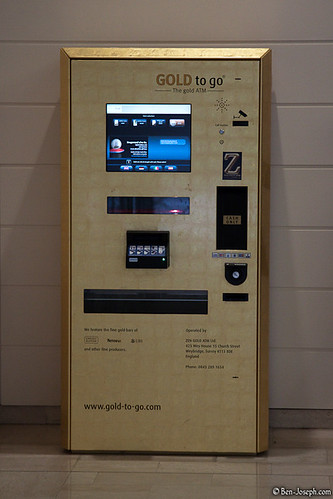
The title sounds a bit weird, but now you can get physical gold bars from an ATM machine instead of cash money. The first gold vending machine that actually spits out gold was presented in (where else) Dubai. But this week I ran in to one in Europe. Now where else than in London, United Kingdom. This is a picture I took of the machine at Westfield London White City Shopping Mall:

GOLD TO GO ATM Machine at Westfield London White City

This surprised me a bit and made me curious if there is a serious business (plan) behind this, or it's just a good marketing stunt?!

The company that created these gold vending machines is: Gold to Go. And, they seem very professional and serious...

This is what they write on their homepage:

"A simple and brilliant principle: put your money in and pick your gold!

The GOLD to go™ vending machine is an unmanned point of sale. It offers an extraordinary opportunity to purchase gold bars and coins of assured quality, backed by the security of a Swabian Fort Knox® and with the ease-of-use of a vending machine. Prices are updated in real-time. The GOLD to go™ gold vending machine is largely burglar-proof and tamper-resistant. It has an excellent user guidance, which makes it very easy to handle.

geschenkbox-krugerrandIn the standard version, our GOLD to go™ ATM’s are equipped with the following products (alternative product portfolio is possible, depending on the requirements of the respective location):

Gold Bars 1 gram, 5 gram, 10 gram and 1 ounce

Krugerrand 1/10 ounce, 1/4 ounce and 1 ounce

Kangaroo 1/10 ounce ($15) and 1 ounce ($100)

Maple Leaf 1/10 ounce ($5)

All these come in a precious gift box."

Today, there are already 27 ATM machines installed: 15 in Germany, 8 in The UAE, 2 in Italy and one each in The USA and The UK.